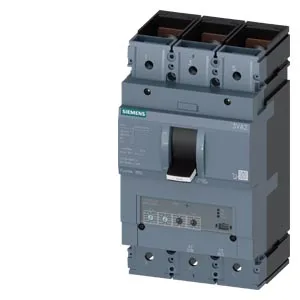
The Siemens SENTRON 3VA2325-6HN32-0CH0 is a 3-pole molded case circuit breaker (MCCB) rated for 250 A continuous current across the full ambient range from 40 °C to 70 °C — no derating needed up to that ceiling. That 250 A figure is the rated uninterrupted current, not a peak or short-time rating; it governs the conductor and bus sizing in the distribution panel. Breaking capacity is 242 kA at 240 V AC, 187 kA at 415 V and 440 V, 121 kA at 500 V, and 7.5 kA at 690 V. The design is line protection, meaning it's optimized for feeder and main breaker duty rather than motor branch circuit protection. Power loss is rated at 40 W maximum, which matters for thermal management inside a sealed enclosure; that figure should be included in the panel's heat dissipation budget.
Dimensions are 138 mm wide, 248 mm high, 110 mm deep. That provides two independent signal contacts for status feedback (e.g., open/closed) plus a dedicated alarm contact that changes state only on a fault trip — useful for remote annunciation without wiring through the main contacts.
The storage limit is the handling limit — the breaker can be stored in unheated warehouses but must be within operating range when energized. No ground-fault monitoring version is fitted; this is a straight overcurrent/line protection device. If ground-fault protection is required, a separate module or a different variant would be needed.