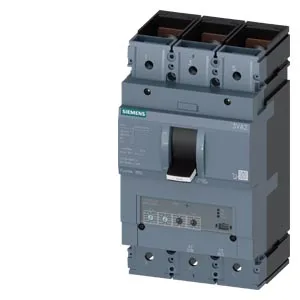
The Siemens SENTRON 3VA2325-6HN32-0DC0 is a 3-pole molded case circuit breaker (MCCB) rated for 250 A continuous current across its full operating temperature range of -25 °C to 70 °C — no derating needed from 40 °C up through 70 °C, which simplifies panel thermal budgeting.
Breaking capacity is the headline number for this class: 242 kA at 240 V AC, 187 kA at 415 V and 440 V, 121 kA at 500 V, and 7.5 kA at 690 V.
Built-in undervoltage release and auxiliary switches
It also carries two HQ auxiliary switches for remote status indication. No communication function, so this is a hardwired panel, not a networked breaker.
Physical fit
The 110 mm depth includes the arc-chamber and terminal depth; leave clearance for cable bending radius below the line-side lugs.
Maximum power loss is 40 W. In a sealed, non-ventilated enclosure, that 40 W contributes to internal temperature rise. If the panel also houses other heat sources (contactors, drives, power supplies), factor this into the thermal calculation — the breaker itself is rated for 70 °C ambient, but adjacent components may not be.