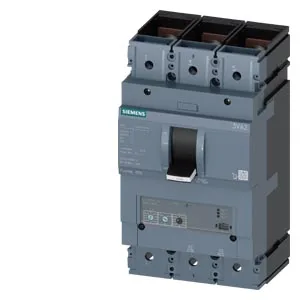
What this MCCB brings to a motor branch
The Siemens 3VA2325-7MN32-0AG0 is a SENTRON molded case circuit breaker in the motor protection variant, rated for 250 A continuous current and built around the ETU350M electronic trip unit. Three poles, no undervoltage release, no communication module — this is a standalone thermal-magnetic replacement with phase failure detection built in. The 330 kA breaking capacity at 240 V tells you it's sized for high-fault panels where a standard MCCB would weld shut. At 690 V it still clears 52.5 kA, so it holds up on the secondary side of a step-down transformer or in a 690 V distribution block.
Thermal derating — the real ampacity
Rated continuous current Iu is 250 A, but that's at 40 °C ambient. The derating curve is flat up to 50 °C (still 250 A), then drops to 240 A at 55 °C, 235 A at 60 °C, 230 A at 65 °C, and 225 A at 70 °C. If this breaker lands in a crowded enclosure with poor airflow, the 70 °C figure is the one to design for. Maximum power loss is 37.5 W — that's the heat you need to vent through the gland plate or forced convection.
Breaking capacity across voltage classes
This MCCB's interrupting rating varies sharply with system voltage: 330 kA at 240 V, 242 kA at 415 V and 440 V, 187 kA at 500 V, and 52.5 kA at 690 V. That 52.5 kA at 690 V is still well above the typical 25–50 kA available fault current on a 690 V industrial bus, so selectivity coordination with downstream breakers is straightforward. The 330 kA at 240 V is overkill for most 240 V panels — it's the same trip unit, just derated for the higher arc voltage.
Panel fit and wiring
Footprint: 248 mm high, 138 mm wide, 110 mm deep. That 138 mm width is the standard 3-pole MCCB envelope for the 3VA2 frame — it occupies the same DIN-rail or screw-mount positions as the 3VA1 and 3VA2 siblings. The auxiliary contact configuration is 1 auxiliary switch plus 1 trip alarm switch (HP type), which gives you one N/O + N/C for status feedback and one dedicated alarm contact that changes state only on a trip event. No undervoltage release, no shunt trip — if you need those, they'd be field-added as separate accessories.
