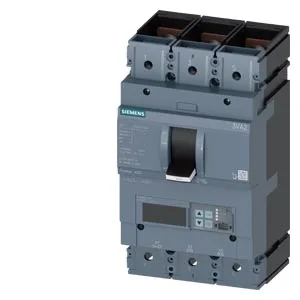
The interrupting ratings tell you where it can sit without cascading upstream: 121 kA at 240 V, 75.6 kA at 415 V and 440 V, 52.5 kA at 500 V, and 7.5 kA at 690 V. That 121 kA figure at 240 V covers high-fault service-entrance applications; the 75.6 kA at 415 V handles most European industrial mains. The breaker communicates (communication function yes), so it can report status or trip events to a BMS or PLC — useful for remote monitoring without a separate aux contact block.
Thermal derating — the real-world continuous current
Above that, the breaker derates linearly: 375 A at 55 °C, 350 A at 60 °C, 325 A at 65 °C, and 300 A at 70 °C. If your panel ambient sits at 55 °C, you lose 25 A of headroom — plan the load accordingly. The maximum power loss is 96 W, which adds to the enclosure's thermal budget.
Dimensions are 110 mm depth, 138 mm width, 248 mm height — a standard MCCB footprint for 400 A frames. The 138 mm width fits a three-pole breaker in a typical distribution section; the 248 mm height clears most deadfronts. Rated insulation voltage is 800 V, and the breaker operates between -25 °C and 70 °C, storing from -40 °C to 80 °C.