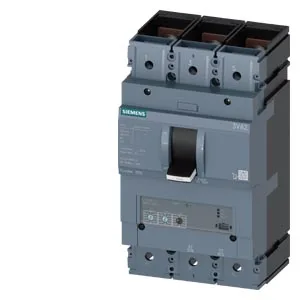
The 400 A rating holds flat from 40 °C up to 50 °C, then derates to 340 A at 70 °C — so in a warm enclosure you lose about 15% of headroom.
This MCCB carries a maximum breaking capacity of 4 000 A and a minimum of 600 A, with the full interrupting curve across common industrial voltages: 187 kA at 240 V, 121 kA at 415 V and 440 V, 75.6 kA at 500 V, and 7.5 kA at 690 V. At 690 V the 7.5 kA rating is lower, so if you're feeding a 690 V drive panel, verify the prospective fault current at that point.
At 55 °C it derates to 385 A, at 60 °C to 370 A, at 65 °C to 355 A, and at 70 °C to 340 A. If the panel sits in a non-conditioned space that hits 55 °C in summer, size the load at 385 A, not 400 A.
Auxiliary contacts and trip indication
The trip alarm signals a fault condition separately from the aux contacts — useful for remote annunciation in a PLC-based distribution monitoring system. The basic switch is 3VA2340-5HL32-0AA0; this -0AJ0 suffix adds the auxiliary and alarm switch block.