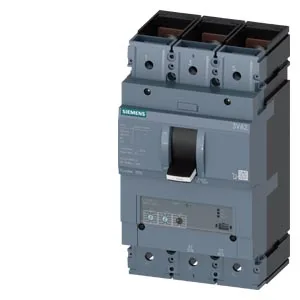
The Siemens SENTRON 3VA2340-5HL32-0JA0 is a 3-pole molded case circuit breaker rated for 400 A continuous current at 40 °C, with a maximum breaking capacity of 187 kA at 240 V AC — that's the interrupting rating you'd need at the main service entrance of a large industrial facility where fault current is highest. At 415 V and 440 V it still holds 121 kA, dropping to 75.6 kA at 500 V and 7.5 kA at 690 V, so the SCCR headroom shrinks fast above 500 V; coordination studies should use the voltage-specific value, not the 240 V headline. The built-in shunt trip release allows remote tripping via a control signal, useful for emergency-stop or load-shedding schemes. The 138 mm width is a three-pole MCCB footprint — standard for a 400 A frame in a distribution panel. Mounting is bolt-on, not DIN-rail; plan for gland-plate clearance and bus-bar takeoff on the line side.
At 55 °C it drops to 385 A, at 60 °C to 370 A, at 65 °C to 355 A, and at 70 °C to 340 A. Max power loss is 96 W at rated load; that heat has to leave the enclosure.