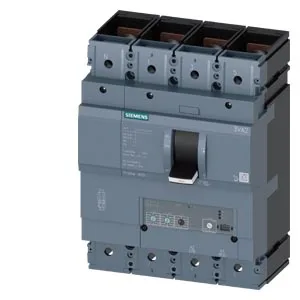
The Siemens SENTRON 3VA2340-5HL42-0CL0 is a 4-pole molded case circuit breaker rated for 400 A continuous current at 40 °C, with a maximum breaking capacity of 187 kA at 240 V. At 415 V and 440 V the breaking capacity holds at 121 kA, dropping to 75.6 kA at 500 V and 7.5 kA at 690 V, so the voltage class of your system determines which rating governs the installation. The continuous current derates from 400 A at 50 °C down to 340 A at 70 °C, meaning the breaker must be sized for the actual ambient temperature in the enclosure, not just the nameplate 400 A. This is a line-protection design (not motor or generator protection), so it's intended for feeder circuits in switchboards and panelboards where the primary need is overcurrent and short-circuit protection of cables and busbars. The 4-pole configuration suits three-phase systems with a fully rated neutral — common in North American 120/208 V and 277/480 V wye services, or European TN systems where the neutral is switched.
That's enough for remote status indication — the trip alarm signals a fault condition, the electrical alarm switch provides a separate signal for the breaker's on/off state, and the two auxiliary switches can be wired into a PLC or SCADA for position feedback. The basic switch assembly is order code 3VA2340-5HL42-0AA0, meaning the -0CL0 suffix adds the UVR and the specific auxiliary switch configuration. If you're replacing a failed unit, verify the aux switch count matches your existing wiring — the 2+1+1 layout is more than the bare minimum and may require additional terminal space in the panel.
For a BOM line, the key fit confirmations are the 400 A continuous rating (verify your load doesn't exceed the derated value at your enclosure ambient), the 4-pole configuration, and the breaking capacity at your system voltage. The 187 kA at 240 V covers most North American low-voltage distribution, while the 121 kA at 415 V suits European 400 V systems. If you're working at 690 V, the 7.5 kA breaking capacity is a significant drop — verify your fault current doesn't exceed that.
Physical integration
The 184 mm width for a 4-pole breaker is typical for the 400 A frame size; verify the mounting footprint matches your existing busbar or lug kit spacing before committing the panel layout. Maximum power loss is 98.5 W at rated current.