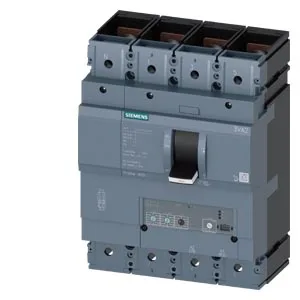
The Siemens SENTRON 3VA2340-5HL42-0HH0 is a 4-pole molded case circuit breaker rated for 400 A continuous current at 40 °C, with a rated insulation voltage of 800 V. It's built for line protection duty — think main feeder or large subfeed in a distribution panel where you need selectivity and a high interrupting rating. The interrupting capacity hits 187 kA at 240 V and 121 kA at 415 V and 440 V, so it handles serious fault current without cascading upstream. That kind of rating means you can place it close to the transformer without worrying about the breaker becoming the weak link in a bolted fault.
Thermal derating and enclosure fit
The breaker holds full 400 A up to 50 °C ambient, then derates to 385 A at 55 °C, 370 A at 60 °C, 355 A at 65 °C, and 340 A at 70 °C. The dimensions are 248 mm high, 184 mm wide, and 110 mm deep. That 184 mm width across four poles is wider than the typical three-pole MCCB; make sure your enclosure backplate or DIN-rail adapter has the real estate before you cut the gland plate. Maximum power loss is 96 W, so factor that into your enclosure thermal rise calculation — especially if you're grouping several breakers in a single section.
Auxiliary contacts and shunt trip
The auxiliary contacts can be wired into a PLC input for breaker status feedback. The integrated auxiliary trip module is order code 3VA9688-0BL30, and the basic switch assembly is 3VA2340-5HL42-0AA0 — both are field-replaceable if a contact wears out.