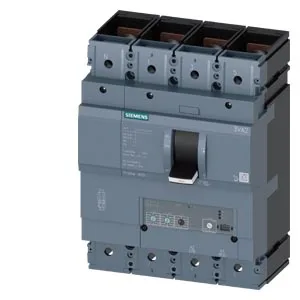
400 A MCCB with 187 kA interrupting capacity — line protection for high-fault panels
The Siemens SENTRON 3VA2340-5HL42-0HL0 is a 4-pole molded case circuit breaker rated for 400 A continuous current, designed for line protection in distribution panels where fault currents can reach 187 kA at 240 V AC. At 415 V and 440 V the interrupting capacity holds at 121 kA, dropping to 75.6 kA at 500 V and 7.5 kA at 690 V — the SCCR headroom is substantial at the common 400 V class, but at 690 V the breaker is effectively limited to low-fault applications. The thermal-magnetic trip curve is flat-rated at 400 A from 40 °C through 50 °C ambient; above that it derates to 385 A at 55 °C, 370 A at 60 °C, 355 A at 65 °C, and 340 A at 70 °C.
Auxiliary and release configuration — what ships inside the cover
The basic switch assembly is order code 3VA2340-5HL42-0AA0 — the -0HL0 suffix adds the auxiliary switch package and shunt trip on top of that base breaker.
Lifecycle and sourcing — current production, quoted to order
Maximum power loss is 96 W at rated load — factor that into the panel thermal budget, especially if the breaker is enclosed with other heat sources.
Physical fit — dimensions and panel integration
The breaker measures 248 mm high, 184 mm wide, and 110 mm deep — a 4-pole frame that occupies roughly 7.24 inches of DIN-rail width. Verify the existing panel cutout and busbar spacing against these dimensions before specifying.