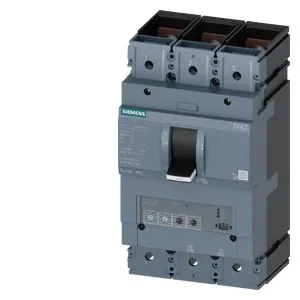
That 400 A holds flat from 40 °C up through 50 °C, then derates to 385 A at 55 °C, 370 A at 60 °C, 355 A at 65 °C, and 340 A at 70 °C — so if your panel runs hot near a row of drives, you still have headroom without upsizing the frame. The interrupting ratings climb to 187 kA at 240 V, drop to 121 kA at both 415 V and 440 V, then 75.6 kA at 500 V, and 17 kA at 690 V. For a 400 A line-up on a 480 V secondary, that 75.6 kA gives you real selectivity headroom against a downstream feeder fault — you're not chasing coordination curves with a marginal breaker.
Trip unit and auxiliary contacts — what's inside
The ETU350 is a basic electronic trip with line protection only — no voltage trigger, no undervoltage release, no phase-failure detection, no ground-fault monitoring, and no communication module. It's a straight feeder breaker for a distribution panel, not a motor-protection device. Latching endurance is rated at 15,000 operations, which is standard for a fixed-mount MCCB in a distribution role.
Physical fit and environmental limits
Dimensions are 248 mm high by 138 mm wide by 110 mm deep — a standard 3-pole MCCB footprint for a 400 A SENTRON frame.