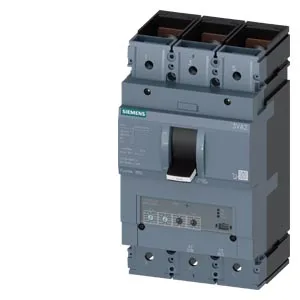
It carries 400 A continuous current at 40 °C through three poles, and its interrupting capacity hits 187 kA at 240 V, 121 kA at 415 V, and 7.5 kA at 690 V — so it handles high-fault utility feeds and transformer secondaries without cascading upstream. Built into a 248 mm high by 138 mm wide by 110 mm deep frame, it fits standard switchboard or panelboard mounting footprints.
Current derating and thermal limits
Above that, it derates linearly: 385 A at 55 °C, 370 A at 60 °C, 355 A at 65 °C, and 340 A at 70 °C. That's the heat the breaker dumps into the enclosure; factor it into your thermal budget if the panel is sealed or has limited ventilation.
That's typical for a high-capacity feeder breaker in a large industrial plant or a utility service entrance. At 690 V the interrupting capacity drops to 7.5 kA — still adequate for most 690 V motor circuits, but verify your available fault current before specifying.
Integration and wiring
Three-pole design with line-side and load-side lugs for copper or aluminum conductors. The shunt trip release (STL) is wired to a remote E-stop or safety relay circuit; the two auxiliary switches HQ provide normally-open/normally-closed contacts for status monitoring. No undervoltage release or ground-fault module on this variant — if you need those, look at the 3VA2 family options with UVR or GF add-ons.