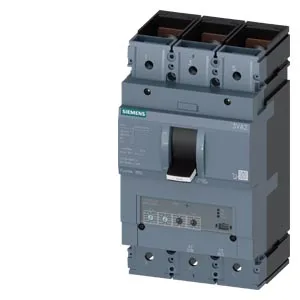
The Siemens SENTRON 3VA2340-5HN32-0JH0 is a 3-pole molded case circuit breaker rated for 400 A continuous current at 40 °C, with a maximum breaking capacity of 187 kA at 240 V AC — that's the headline figure for high-fault utility feeds or transformer secondaries where available fault current can exceed 100 kA. At 415 V and 440 V it still holds 121 kA, and at 500 V it delivers 75.6 kA, so it covers most industrial distribution voltages without needing a current-limiting upstream device. The 690 V rating drops to 7.5 kA, which is typical for a 400 A frame at that voltage — fine for motor circuits on 690 V systems where the transformer impedance limits fault current. This is a line-protection design, meaning the trip curve and thermal-magnetic or electronic trip unit are set for cable and busbar protection rather than motor or generator protection.
Thermal derating — the real-world continuous current
At 55 °C it derates to 385 A, at 60 °C to 370 A, at 65 °C to 355 A, and at 70 °C to 340 A.
Dimensions are 248 mm high, 138 mm wide, 110 mm deep — a standard 3-pole MCCB footprint for a 400 A frame. Depth of 110 mm includes the arc chamber and terminal clearance; verify gland-plate depth if the breaker mounts near the enclosure back wall.