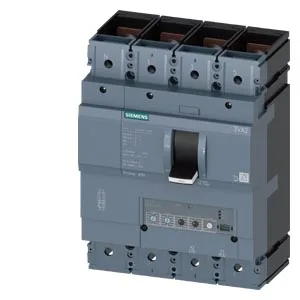
400 A MCCB with 187 kA interrupting capacity — SENTRON 3VA2 platform
The Siemens 3VA2340-5HN42-0AH0 is a 4-pole molded case circuit breaker from the SENTRON 3VA2 series, rated for 400 A continuous current at 40 °C ambient. Its interrupting capacity reaches 187 kA at 240 V AC, 121 kA at 415 V, and 75.6 kA at 500 V — figures that place it squarely in high-fault-duty distribution, not branch-circuit protection. The 96 W maximum power loss is a panel-cooling consideration: at full load the heat dissipation is comparable to a small drive, so ventilation slots or forced airflow in a sealed enclosure should be factored in.
Selectivity and coordination — what the interrupting ratings mean for your distribution
For a site electrical engineer building a selective coordination study, these numbers tell you the 3VA2340-5HN42-0AH0 can be placed upstream of lower-rated branch breakers without cascading failure — provided the let-through energy curves are verified. The 400 A continuous rating holds steady through 50 °C, then derates to 385 A at 55 °C, 370 A at 60 °C, 355 A at 65 °C, and 340 A at 70 °C — a 15 % reduction at the top end. Panel builders should size the enclosure and buswork for the full 400 A at the expected ambient, not the derated value.