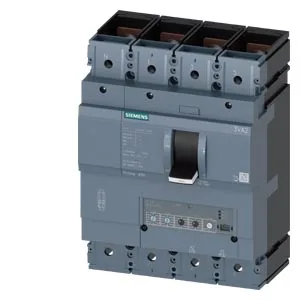
The breaking capacity varies by system voltage: 187 kA at 240 V, 121 kA at 415 V and 440 V, 75.6 kA at 500 V, and 17 kA at 690 V — so at 480 V you interpolate between the 440 V and 500 V figures, which is typical for a large-frame MCCB protecting a transformer or main feeder. The ETU350 is a basic electronic trip unit with adjustable overload and short-circuit settings, but no communication, phase-failure detection, or ground-fault monitoring — it's a line-protection device, not a motor-protection or power-monitoring breaker. Thermal derating is published: the breaker holds 400 A up to 50 °C, then drops to 385 A at 55 °C, 370 A at 60 °C, 355 A at 65 °C, and 340 A at 70 °C. Maximum power loss is 98.5 W, which matters for enclosure heat load calculations.
The breaker measures 184 mm wide by 248 mm high by 110 mm deep — a standard footprint for a 400 A 4-pole MCCB in the SENTRON 3VA2 frame. It mounts with four screws to a backplate or mounting rail; no DIN-rail clip on this frame size. The undervoltage release and auxiliary contact pack are factory-integrated, so no field-assembly of those accessories is needed — just wire the line and load lugs, connect the UVR coil to the control voltage, and terminate the auxiliary contacts into the PLC or status-monitoring input. The ETU350 trip unit is the supplied basic switch variant (3VA2340-5HN42-0AA0) with the electronic trip module built in. No communication module, so no Modbus or PROFIBUS interface — this is a straightforward distribution breaker, not a smart breaker. The 4-pole design with neutral protection is typical for North American 120/208 V or 277/480 V wye systems where the neutral needs overcurrent protection.