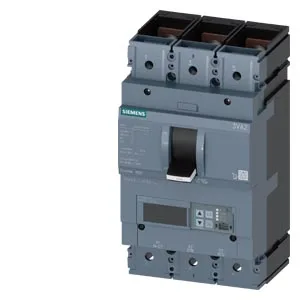
Above that, the thermal curve steps down: 375 A at 55 °C, 350 A at 60 °C, 325 A at 65 °C, and 300 A at 70 °C. For a panel that runs warm — say, a packed switchboard at 55 °C — the effective rating drops to 375 A, so size your bus and downstream gear accordingly. At 240 V it interrupts 187 kA; at 415 V and 440 V it holds 121 kA; at 500 V it drops to 75.6 kA; at 690 V it is 17 kA. The ETU550 electronic trip unit provides adjustable long-time, short-time, instantaneous, and ground-fault protection curves. It also supports communication, meaning it can report status and trip events over the SENTRON communication bus — useful for a plant-wide power monitoring system. The auxiliary contact version is two HQ switches, and the integrated auxiliary trip is a separate order code 3VA9608-0BB11.
This is a 3-pole MCCB in the SENTRON 3VA platform. Power dissipation is 98.5 W maximum — that heat must be ventilated or accounted for in the enclosure thermal calculation. The undervoltage release (UVR) is built in. The trip indicator is not present; status is read from the auxiliary switches or the communication bus.