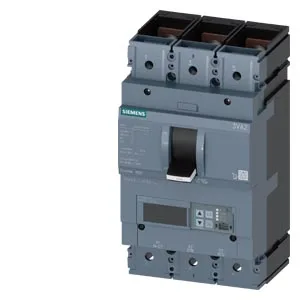
At 240 V it clears 187 kA; at 415 V and 440 V it holds 121 kA; at 500 V it drops to 75.6 kA; at 690 V it is 17 kA. For a typical 400 V industrial service with a transformer rating that yields a 50–65 kA prospective fault current, this breaker has comfortable margin. At 690 V the 17 kA figure is low — verify your system's available fault current before specifying it on a 690 V line. This is the version with line protection firmware, meaning it is optimized for feeder protection rather than motor or generator duty. An undervoltage release (UVR) is built in — when control voltage drops, the breaker trips, which is standard for emergency-stop or loss-of-mains schemes.
The breaker measures 138 mm wide, 248 mm high, and 110 mm deep. Maximum power loss is 98.5 W. In a sealed enclosure this heat must be managed — at 400 A continuous load, the breaker dissipates nearly 100 W. Ensure the enclosure has adequate ventilation or forced cooling to keep internal ambient below 50 °C if you want to hold the full 400 A rating. Mechanical endurance is rated at 15 000 operations, which is standard for a fixed-mounted MCCB in a distribution panel — not a switching duty cycle, but fine for occasional on-load switching and fault isolation.