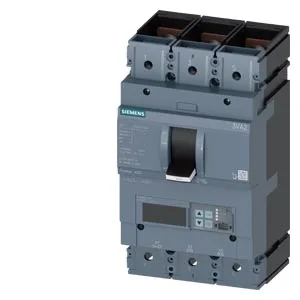
Its job is to clear faults fast enough that upstream gear doesn't trip. Above that, it derates: 375 A at 55 °C, 350 A at 60 °C, 325 A at 65 °C, and 300 A at 70 °C. If your enclosure hits 70 °C, you lose 100 A of headroom; plan the thermal budget accordingly. At 240 V it clears 187 kA — that's utility-grade fault current. At 500 V it drops to 75.6 kA, and at 690 V it's 7.5 kA. If your system runs 690 V, this is not the breaker for that bus; the 7.5 kA rating is too low for most industrial 690 V applications.
The 110 mm depth fits shallow enclosures with wiring room. Maximum power dissipation is 96 W at full rated load.
Trip unit and adjustability
The electronic trip unit is adjustable between 600 A and 4 000 A — that's the short-circuit and ground-fault pickup range, not the continuous current rating. The continuous rating is fixed at 400 A (the frame size). The trip indicator is not present on this variant, so there's no local mechanical flag showing the breaker tripped on fault vs. manual open. No undervoltage release or voltage-triggered shunt trip fitted. For remote trip, use the basic switch variant or add an external release module.
Auxiliary contacts and communication
These are wired back to a PLC or status lamp to indicate open/closed state of the breaker. Communication function is present for remote monitoring and trip data.