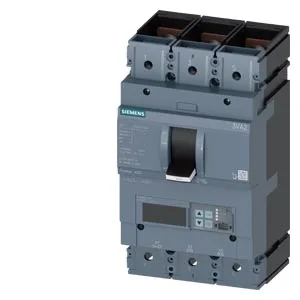
At 240 V it interrupts 187 kA; at 415 V and 440 V that figure holds at 121 kA, dropping to 75.6 kA at 500 V and 17 kA at 690 V — so the breaker is sized for high-fault installations where upstream transformer capacity or parallel-feed architecture drives available fault current above 100 kA at typical distribution voltages. The 400 A rating holds from 40 °C through 50 °C ambient; above that it derates to 375 A at 55 °C, 350 A at 60 °C, 325 A at 65 °C, and 300 A at 70 °C, which is the maximum operating temperature.
Built-in communication and auxiliary functions
The integrated auxiliary trip is order code 3VA9608-0BB11. The supplied basic switch is 3VA2340-5JQ32-0AA0. For a panel integrator, the communication function means the breaker can report status and trip events into a higher-level control system — useful for remote monitoring or coordinated shutdown sequences.
Physical fit and environmental range
Dimensions are 248 mm height, 138 mm width, and 110 mm depth. Maximum power loss is 98.5 W — a figure to factor into enclosure thermal calculations, especially when multiple breakers are ganged. No trip indicator is fitted; no voltage trigger; no phase failure detection; no other measurement function beyond the ground-fault monitoring.