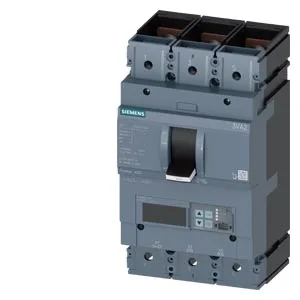
The Siemens 3VA2340-5JQ32-0JA0 is a SENTRON molded case circuit breaker (MCCB) rated for 400 A continuous at 40 °C, 3-pole, with an ETU560 electronic trip unit. That 400 A holds flat through 50 °C — you only start derating at 55 °C (375 A) and 60 °C (350 A), so it handles warm enclosures without oversizing. The 187 kA interrupting rating at 240 V (121 kA at 415/440 V, 75.6 kA at 500 V, 7.5 kA at 690 V) gives you serious fault-current headroom for low-voltage distribution; the 800 V rated insulation voltage (Ui) confirms it's built for 690 V line-to-line systems.
Line protection, communication-ready — deployment context
This is the line protection version, meaning the trip curve and accessories are optimized for feeder and main breaker duty rather than motor or generator protection. It carries a communication function — the ETU560 supports the SENTRON communication module for PROFIBUS or PROFINET, so you can pull trip data and event logs into a PLC or SCADA. The front face is IP40 rated, suitable for enclosed panel mounting; no auxiliary contacts are fitted as standard, but the accessory slot accepts them. Dimensions are 248 mm high, 138 mm wide, 110 mm deep — a standard 3-pole MCCB footprint for a 400 A frame. Maximum power loss is 96 W, worth factoring into your enclosure thermal budget.
Selectivity and coordination — the ETU560 advantage
The ETU560 gives you four adjustable protection functions: L (long-time), S (short-time with I²t on/off), I (instantaneous), and G (ground-fault). The short-time delay lets you achieve full selectivity with downstream breakers up to the short-time withstand rating, which on a 400 A frame is typically high enough to avoid nuisance trips on motor-start inrush.