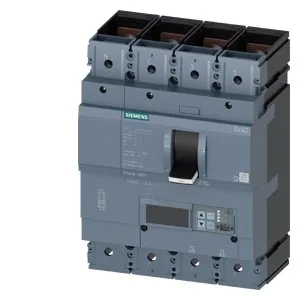
At 240 V it interrupts 187 kA; at 415 V and 440 V that figure holds at 121 kA, dropping to 75.6 kA at 500 V and 17 kA at 690 V — so the breaker's SCCR headroom is highest on lower-voltage 480 V or 240 V delta services, and you need to verify coordination at 690 V if that's your line voltage. The 400 A rating holds from 40 °C through 50 °C ambient; above that it derates linearly to 300 A at 70 °C, which governs placement in a warm enclosure or next to heat-generating gear.
Trip unit, auxiliaries, and ground-fault monitoring
The ETU560 release is an electronic, LSI (long-time, short-time, instantaneous) trip with adjustable curves — not a thermal-magnetic, so it gives better selectivity coordination downstream. The breaker ships with three HQ auxiliary switches (3VA9608-0BB24) and a summation-current ground-fault module that monitors L+N conductors, but no undervoltage release or voltage-trip accessory is fitted. Communication is onboard (PROFIBUS or PROFINET via the 3VA9 communication module, not included), which lets the breaker report status and trip events to a PLC or energy management system without a separate I/O block.
At 248 mm high, 184 mm wide, and 110 mm deep, this 4-pole breaker occupies a standard MCCB footprint for 400 A frames. The 110 mm depth is the body-only dimension; allow additional clearance for the rotary handle, auxiliary wiring, and communication cable bend radius.