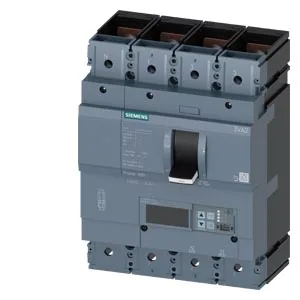
It's a 4-pole unit designed to sit in a distribution panel or switchboard — the 248 mm height, 184 mm width, and 110 mm depth (9.76 x 7.24 x 4.33 in) tell you the cubicle cutout and busbar spacing needed. The interrupting ratings are what decide whether it clears a fault without upstream damage: 187 kA at 240 V, 121 kA at 415 V and 440 V, 75.6 kA at 500 V, and 7.5 kA at 690 V. At 690 V the capacity drops sharply — that's the voltage class where the arc energy saturates the internal arc chamber; if your system runs 690 V with available fault current above 7.5 kA, this breaker isn't the right fit. Above that, it steps down: 375 A at 55 °C, 350 A at 60 °C, 325 A at 65 °C, and 300 A at 70 °C. Maximum power loss is 96 W, which adds to the enclosure's thermal load.
The 3VA2340-5JQ42-0AF0 carries a communication function, which means it can integrate with monitoring systems — useful for a plant that tracks breaker status or load profiles.
Installation and integration notes
Mounts in a standard switchboard or distribution panel — the 184 mm width and 248 mm height fit common MCCB cubicle cutouts. The 110 mm depth leaves room for rear bus connections and wiring ducts. It's a 4-pole breaker, so it needs four conductors plus a neutral if the system requires it. The basic switch variant is listed as 3VA2340-5JQ42-0AA0, which is the same frame without the communication module; this version adds the comms function on top of the base switch. No undervoltage release is fitted, and no voltage trigger — if you need undervoltage protection, you'd add an external release module.