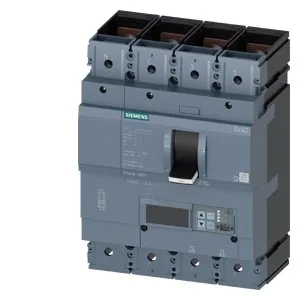
The Siemens SENTRON 3VA2340-5JQ42-0AJ0 is a 4-pole molded case circuit breaker rated 400 A continuous at 40 °C, with a maximum interrupting capacity of 187 kA at 240 V AC. At 415 V and 440 V the interrupting rating drops to 121 kA, and at 690 V it falls to 7.5 kA, so the voltage class of your distribution system directly governs whether this breaker is the right choice. This is a line-protection design (not motor or generator protection), so the trip curve and accessories are optimized for feeder and main breaker duty.
The 110 mm depth leaves room for rear-access wiring in a typical 600 mm deep enclosure. Four poles mean it needs four line and four load conductors; plan your gland plate and busbar layout accordingly.
Thermal management and power loss
Maximum power loss is 96 W at rated current. That is not trivial — in a sealed, uncooled panel the heat adds up. If you are packing multiple breakers in a small enclosure, factor the 96 W into your thermal calculation to avoid nuisance tripping from ambient rise.