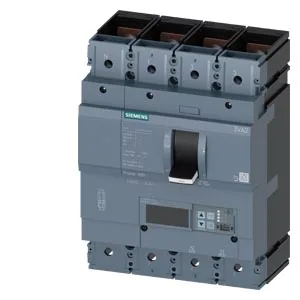
What this 4-pole 400 A MCCB carries
Its interrupting capacity reaches 187 kA at 240 VAC, 121 kA at 415/440 VAC, 75.6 kA at 500 VAC, and 7.5 kA at 690 VAC — so at typical 400 V class industrial voltages it clears faults well above the 50–65 kA most service-entrance breakers are rated for, meaning it can be used as a main or large feeder breaker without cascading concerns. The thermal-magnetic trip unit is adjustable from 600 A minimum to 4000 A maximum, with a factory-default full-scale value of 400 A. That wide adjustment range lets one frame size cover multiple load banks — set it at 600 A for a 250 kW motor feeder or dial it up to 4000 A for a transformer secondary or bus riser.
Above 50 °C it derates linearly: 375 A at 55 °C, 350 A at 60 °C, 325 A at 65 °C, and 300 A at 70 °C. The breaker dissipates 98.5 W maximum at rated load, so ventilation or spacing in the enclosure matters. Physical footprint is 248 mm high, 184 mm wide, 110 mm deep — a 4-pole frame that fits standard SENTRON mounting plates and busbar systems. The depth is shallow enough for 300 mm deep enclosures with wiring gutters.
Built-in accessories and communication
The UVR drops the breaker if control voltage falls below its dropout threshold — standard practice for emergency-stop circuits and undervoltage protection on motor feeders. Communication function is onboard, so it can integrate with a BMS or SCADA system for remote trip indication and load monitoring. The basic switch version is 3VA2340-5JQ42-0AA0 — this -0CH0 suffix adds the UVR and the HQ auxiliary switch complement. If your BOM already specifies the -0AA0 and you need undervoltage protection, this is the drop-in upgrade without changing mounting or bus connections.