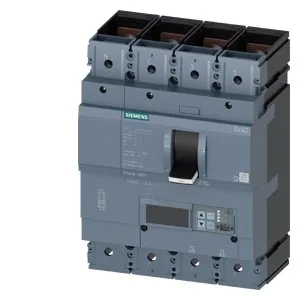
What this 400 A MCCB does for a line-side feeder
At 400 V and 440 V the interrupting rating holds at 121 kA, dropping to 75.6 kA at 500 V and 17 kA at 690 V. That voltage-dependent curve is typical for MCCBs — the arc extinguishes harder at higher voltage, so the rating falls off. For a 480 V panel feeding a motor control center, the 121 kA at 415 V is the relevant figure; at 480 V the available fault current is usually lower, but the 121 kA gives you margin. If the panel sits in a hot mezzanine or near a furnace line, that derating curve is what you size the feeder for — not the 400 A nameplate.
Panel fit and integration details
The 184 mm width is a four-pole frame. Maximum power dissipation is 98.5 W at rated load — that heat has to leave the enclosure. In a packed panel with multiple breakers side by side, the cumulative dissipation drives the ventilation or forced-air calculation.
Ground fault and release options
This variant includes ground-fault monitoring via summation current formation on the L + N conductor — it sums the phase and neutral currents and trips if the residual exceeds the threshold set in the ETU560. No voltage trigger or phase failure detection is fitted; those are separate accessory options if the application requires them. For a feeder breaker that cycles once or twice a day, that is effectively lifetime. For a breaker that sees daily load switching (like a welder supply), it is worth tracking the count.