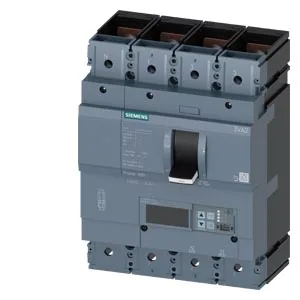
What this 4-pole MCCB is and what it does
The Siemens 3VA2340-5JQ42-0JH0 is a SENTRON molded case circuit breaker (MCCB) designed for line protection in industrial distribution panels. It's a 4-pole unit rated 400 A continuous at 40 °C, with an adjustable thermal-magnetic trip range from 600 A minimum to 4000 A maximum — so you set the pickup to match your downstream load, not the other way around. The interrupting ratings climb with voltage: 187 kA at 240 V, 121 kA at 415 V and 440 V, 75.6 kA at 500 V, and 7.5 kA at 690 V. That 187 kA figure at 240 V tells you this breaker handles high-fault conditions on the secondary side of a step-down transformer without needing a current-limiting fuse upstream. It ships with a shunt trip (STL) auxiliary release and a configurable auxiliary switch block — 2 auxiliary switches plus 1 trip alarm switch (HQ designation). The basic switch core is order code 3VA2340-5JQ42-0AA0, meaning the -0JH0 suffix adds the shunt trip and the specific aux contact arrangement.
Thermal derating and real-world current capacity
The breaker holds its full 400 A rating from 40 °C through 50 °C. Above that it derates linearly: 375 A at 55 °C, 350 A at 60 °C, 325 A at 65 °C, and 300 A at 70 °C. If your panel ambient runs hot — say next to a drive cabinet or in a non-conditioned enclosure — the 70 °C figure of 300 A is the one to spec against, not the nameplate 400 A. Maximum power loss is 96 W at rated current. That's the heat you need to vent from the enclosure; for a 4-pole breaker at 400 A, it's modest enough for a standard ventilated panel but worth checking if you're packing multiple breakers in a sealed box.
Physical fit and panel integration
Dimensions are 248 mm high, 184 mm wide, 110 mm deep. That's a 4-pole frame size — wider than a 3-pole equivalent by roughly one pole pitch. The 110 mm depth is shallow enough for most standard distribution enclosures; check your back-panel clearance if you're mounting it behind a door with a deep rotary handle mechanism. Operating temperature range is -25 °C to 70 °C; storage range is -40 °C to 80 °C. The storage limit governs shipping and warehouse conditions, not running duty — if it sat in an unheated warehouse at -30 °C, it's fine to install once warmed above -25 °C.
