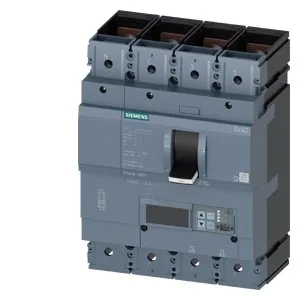
It carries a breaking capacity of 187 kA at 240 V, 121 kA at 415 V, and 75.6 kA at 500 V — numbers that tell you it can interrupt massive fault currents without letting an arc cascade upstream.
That thermal performance matters when you're packing this breaker into a crowded panel with other heat sources; you don't lose headroom just because the ambient creeps up. The rated insulation voltage Ui of 800 V means it's rated for 690 V systems with margin, and the 4-pole design lets you switch all three phases plus neutral in a single unit — common in North American 277/480 V wye or European 400/230 V TN systems. Dimensions of 248 mm high by 184 mm wide by 110 mm deep fit standard MCCB footprints, so it drops into existing switchboard cutouts without panel rework.
The ETU560 overcurrent release is a programmable electronic trip unit that supports LSI protection (long-time, short-time, instantaneous) and includes ground-fault monitoring via summation current formation on L + N conductors. That's enough status feedback for a PLC to know whether the breaker is on, off, or tripped — no separate relay interface needed. Communication function is built in, so it can talk to a higher-level system for energy monitoring or remote control without an add-on module.