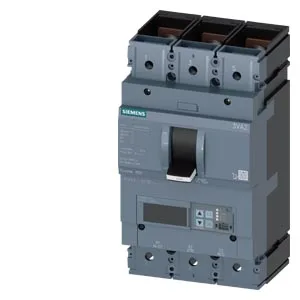
What the ratings mean for your panel
The Siemens SENTRON 3VA2340-5KP32-0DL0 is a 3-pole molded case circuit breaker (MCCB) rated for 400 A continuous current at 40 °C, with a rated insulation voltage of 800 V. The 187 kA breaking capacity at 240 V means it can safely interrupt fault currents up to that level without upstream cascading — essential for high-fault service-entrance or distribution panels where SCCR headroom is tight. At 415 V and 440 V the rating holds at 121 kA, and it still delivers 75.6 kA at 500 V, so it covers most industrial voltage levels without derating the interrupting rating until you hit 690 V (17 kA). The ETU850 electronic trip unit gives you adjustable long-time, short-time, instantaneous, and ground-fault protection curves — this is a selective breaker, not a thermal-magnetic fixed-trip device. The 400 A rating holds flat from 40 °C through 50 °C, then derates linearly to 300 A at 70 °C. If your panel ambient runs above 50 °C, size the breaker for the derated value — the 375 A at 55 °C and 350 A at 60 °C are the real-world limits, not the nameplate 400 A.
Integration and mounting
Panel footprint: 248 mm high, 138 mm wide, 110 mm deep. Mounts on a standard DIN rail or direct panel-mount via the screw terminals. The auxiliary contact configuration — 2 auxiliary switches + 1 trip alarm switch + 1 electrical alarm switch HQ — gives you status feedback for PLC or SCADA without an external interposing relay. Power loss is 98.5 W maximum at rated current — account for that heat in the enclosure thermal calculation, especially if the panel is densely packed. The operating range is -25 °C to 70 °C; storage range is -40 °C to 80 °C.
Communication and auxiliary functions
The communication function and other measurement function indicate this variant supports remote monitoring and parameterization — likely via the SENTRON communication modules (PROFIBUS, PROFINET, or Modbus), though the specific protocol is not listed here. The undervoltage release (UVR) is integrated, so the breaker trips on loss of control voltage — standard for safety circuits where a voltage-drop must open the circuit. Latching endurance is rated at 15,000 operations — mechanical life, not electrical load-switching. For frequent switching duty, factor in the electrical endurance curve (not provided here) which will be lower under load.
