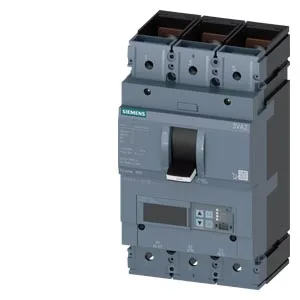
It carries a 187 kA breaking capacity at 240 V, derating to 121 kA at 415 V and 440 V, 75.6 kA at 500 V, and 17 kA at 690 V — numbers that define the fault-clearing envelope for panel coordination studies.
Above 55 °C the rating derates linearly — 375 A at 55 °C, 350 A at 60 °C, 325 A at 65 °C, and 300 A at 70 °C — so an enclosure with poor ventilation or a high ambient temperature forces a larger frame. The 187 kA interrupting rating at 240 V is the maximum fault current the breaker can safely clear at that voltage; at 690 V that drops to 17 kA, which matters for 690 V drives or transformer secondaries.
The ETU850 trip unit is user-accessible for setting the long-time, short-time, instantaneous, and ground-fault pickup levels via the front-panel rotary dials and DIP switches. The shunt trip (STL) release allows remote tripping from a PLC or emergency-stop circuit. Power loss is rated at 96 W maximum, so account for that heat load in the enclosure thermal calculation.
Peer Comparison
Compared to the 3VA1110-5EE32-0JA0, which is a 100 A frame with a basic thermal-magnetic trip, this 3VA2340-5KP32-0KL0 is a 400 A frame with an electronic ETU850 trip unit. If your panel was specified around a 5SQ2370-2YA01, that is a different brand and frame; the 3VA2340-5KP32-0KL0 will not drop in without rewiring and a coordination study.