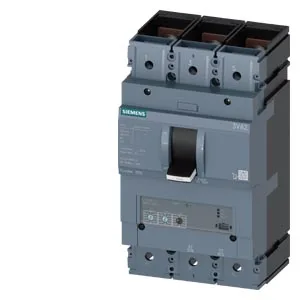
The electronic trip unit is an ETU850 with LSI protection: Long-time (overload) pickup Ir adjustable 160 A to 400 A, Short-time (short-circuit with delay) Isd adjustable 0.6 to 10× In, and Instantaneous Ii adjustable 1.5 to 10× In. That LSI curve gives you selectivity downstream — you can coordinate with feeder breakers so a fault on a branch trips only the branch breaker, not this main. The built-in undervoltage release is rated 208-230 V AC 50/60 Hz, so if control power drops, the breaker opens automatically.
The description also notes an undervoltage release accessory for 3VA1 — that's the release itself, already fitted in this variant, so verify your control voltage matches the 208-230 V AC coil before wiring.
The 400 A continuous rating (In) and the 160-400 A overload range (Ir) mean this breaker fits as a main or large feeder in a 400 A panelboard. Class M (medium) breaking capacity is the standard choice for most industrial switchboards; class H (high) would be needed for high-fault locations like near a transformer secondary. The 4-pole configuration with adjustable neutral protection is useful for 3-phase + N systems where you want to protect the neutral conductor against overload, common in panels feeding mixed single-phase and three-phase loads. The nut keeper kit is a captive hardware feature that prevents loose nuts falling into live buswork during installation — a practical panel-builder detail.