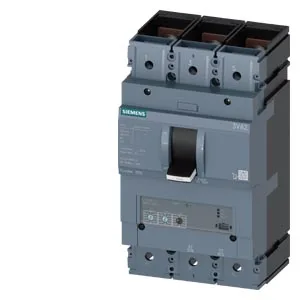
It carries a maximum breaking capacity of 242 kA at 240 V and 187 kA at 415 V or 440 V, which means it can safely interrupt high fault currents on the secondary side of a large transformer or at a main feeder without cascading upstream. The frame is sized for a 600 A minimum to 4 000 A maximum trip unit range, so this breaker sits at the lower end of the frame's capacity — common for a main or large feeder breaker in a 400 A rated panel.
Breaking capacity drops as system voltage rises: 242 kA at 240 V, 187 kA at both 415 V and 440 V, 121 kA at 500 V, and 7.5 kA at 690 V. The steep drop at 690 V (7.5 kA) means this breaker is not suited for 690 V main feeders in high-fault installations — the frame is optimized for 240–500 V distribution. At 400 V class (common in European industrial panels), 187 kA covers virtually any fault scenario short of a dedicated transformer secondary.
Above that, derating begins: 385 A at 55 °C, 370 A at 60 °C, 355 A at 65 °C, and 340 A at 70 °C.
Integrated undervoltage release, no auxiliary switch
It ships without an auxiliary switch (no remote status indication) and without ground-fault monitoring. The trip indicator is also absent, so visual confirmation of trip state requires looking at the handle position. If remote signaling or ground-fault protection is needed, a different 3VA variant with those options should be specified.
Physical dimensions and panel fit
Dimensions: 110 mm depth, 138 mm width, 248 mm height. Depth of 110 mm leaves clearance for rear terminals and arc chutes; verify the enclosure depth allows the required bending radius for incoming cables.
Maximum power loss is 98.5 W at rated current. This heat must be dissipated within the enclosure — for a panel with multiple breakers, the cumulative loss drives ventilation or derating decisions. At 400 A continuous, the 98.5 W loss is typical for a thermal-magnetic MCCB of this frame size.