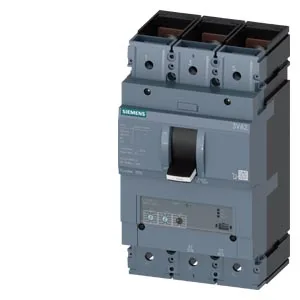
The Siemens SENTRON 3VA2340-6HL32-0CC0 is a 3-pole molded case circuit breaker (MCCB) rated for 400 A continuous at 40 °C, with a maximum interrupting capacity of 242 kA at 240 V. The 400 A frame is thermally rated; at elevated ambient temperatures the continuous current derates: 385 A at 55 °C, 370 A at 60 °C, 355 A at 65 °C, and 340 A at 70 °C. The interrupting rating varies by voltage: 187 kA at 415 V and 440 V, 121 kA at 500 V, and 7.5 kA at 690 V.
Dimensions are 248 mm high, 138 mm wide, 110 mm deep — a standard 3-pole MCCB footprint for the 400 A frame. Maximum power loss is 98.5 W at rated current — that heat must be evacuated from the enclosure.
The breaker ships with two factory-installed HQ auxiliary switches and an undervoltage release (UVR). The HQ designation indicates high-rupturing-capacity microswitches suitable for direct control-circuit switching without interposing relays. There is no voltage-trip feature, no ground-fault monitoring, and no communication function on this variant; those are available on other 3VA order codes.