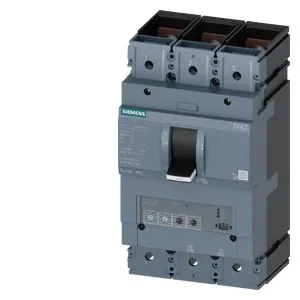
The Siemens SENTRON 3VA2340-6HN32-0JA0 is a 3-pole molded case circuit breaker rated for 400 A continuous current at 40 °C through 50 °C without derating — at 55 °C it still holds 385 A, and at 70 °C it carries 340 A. Breaking capacity is 242 kA at 240 V AC, 187 kA at 415 V and 440 V, 121 kA at 500 V, and 40 kA at 690 V. That 242 kA figure at 240 V covers high-fault utility feeds in North American panels; the 187 kA at 415 V handles European 400 V distribution. The 40 kA at 690 V is still substantial for industrial 690 V networks. This is a line protection version — not a motor protection breaker. It's designed for cable and busbar protection in main or sub-distribution boards.
Dimensions are 248 mm height, 138 mm width, 110 mm depth. The 110 mm depth is the critical dimension for shallow gland-plate enclosures — verify your back-panel clearance before committing. Maximum power loss is 96 W at rated current.
What's not on this variant
This order code comes without auxiliary contacts, without an undervoltage release, without ground fault monitoring, without phase failure detection, and without communication functions. The only auxiliary release is the shunt trip (STL). No trip indicator is fitted. If you need any of those options, you're looking at a different suffix in the 3VA2 family. For a main breaker that cycles infrequently (a few times a year), this is more than adequate. For a frequently switched load-break application, you'd want to check the electrical endurance curve separately.