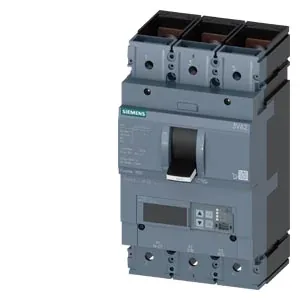
That 400 A holds flat from 40 °C up to 50 °C — no derating needed in a typical 40 °C panel — then steps down to 375 A at 55 °C and 300 A at 70 °C. The interrupting ratings are the real story: 242 kA at 240 V, 187 kA at 415 V and 440 V, 121 kA at 500 V, and 40 kA at 690 V. Those are high-end fault-clearing numbers; this breaker handles bolted faults in heavy industrial distribution without cascading upstream. The overcurrent release is an ETU550 — electronic trip unit, typically offering LSI (long-time, short-time, instantaneous) protection curves with adjustable settings. Communication function is built in, so it can talk to a higher-level system for monitoring and remote trip. It ships with three auxiliary switches (HQ type) for status feedback. Power loss maxes at 96 W — plan for that heat in a closed enclosure. Mechanical endurance is 15,000 cycles; that's typical for a 400 A frame — not a daily-switch application, but fine for infrequent maintenance disconnects.
The breaker footprint is 138 mm wide, 248 mm tall, 110 mm deep. Verify gland-plate cutout against the 138 mm width; it's wider than a typical 250 A frame, so a panel originally laid out for a smaller MCCB may need a filler plate.