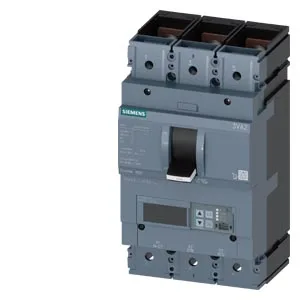
The 3VA2340-6JP32-0AE0: The 242 kA at 240 V is the maximum short-circuit current this MCCB can safely interrupt — that figure drops to 187 kA at 415 V and 440 V, 121 kA at 500 V, and 40 kA at 690 V. For a site electrical engineer coordinating a distribution board, the 187 kA at 415 V gives substantial headroom above typical utility fault levels (usually 25–50 kA), so you can maintain selectivity with downstream breakers without oversizing the main.
Above that, derate linearly: 375 A at 55 °C, 350 A at 60 °C, 325 A at 65 °C, and 300 A at 70 °C. The 110 mm depth and 138 mm width fit a standard MCCB footprint — verify the gland plate cutout against the 248 mm height before laying out the backpanel.
Trip unit and auxiliary configuration
It supports communication via the integrated communication function — this is the variant that talks to a PLC or BMS, not a standalone thermal-magnetic. No undervoltage release or shunt trip is included; those are ordered separately as the 3VA9608-0BB11 auxiliary trip.