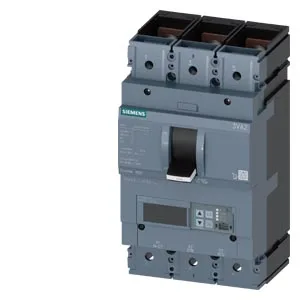
What this 400 A MCCB delivers — and where the ratings bite
Above that, the thermal trip derates linearly — 375 A at 55°C, 350 A at 60°C, 325 A at 65°C, and 300 A at 70°C. That derating curve is the real-world limit for a warm panel; if your enclosure ambient sits at 55°C, you're buying a 375 A breaker, not 400 A. Interrupting capacity is the headline: 242 kA at 240 V, dropping to 187 kA at 415 V and 440 V, then 121 kA at 500 V, and 7.5 kA at 690 V. That 242 kA figure at 240 V covers high-fault service-entrance applications; the steep drop to 7.5 kA at 690 V means this is not a 690 V main breaker for high-fault industrial grids — it's sized for 480 V or 600 V class systems where the available fault current stays under 121 kA. No ground-fault monitoring is included; if GF protection is needed, that's an external module or a different variant.
Panel fit and mounting — 110 mm depth matters
The MCCB measures 110 mm deep by 138 mm wide by 248 mm high. The 138 mm width for a 3-pole frame is standard for SENTRON 3VA2 fixed breakers; verify that the existing busbar or cable lug kit matches the line-side terminal centers before committing the panel layout.
Auxiliaries and communication — what's built in
The breaker includes a communication function — the 3VA2 platform supports optional communication modules (PROFIBUS, PROFINET, Modbus) for power monitoring and remote trip indication. The base unit ships with two HQ auxiliary switches and an undervoltage release. The trip indicator is not present on this variant, so no local mechanical flag for trip cause — that data comes through the communication interface or the aux switches.