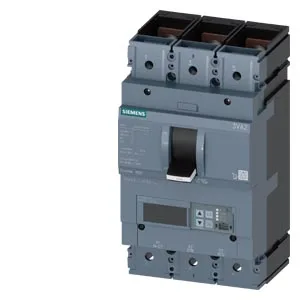
What you're looking at
This is a Siemens SENTRON 3VA2340-6JP32-0DH0 molded case circuit breaker — 3-pole, 400 A continuous, line-protection design. The 242 kA interrupting capacity at 240 V means it handles serious fault currents without cascading upstream; at 415 V and 440 V it still holds 187 kA, and at 500 V it's 121 kA. The 690 V rating drops to 7.5 kA — that's the voltage limit for this frame. The UVR means the breaker drops if control voltage falls below the dropout threshold — standard for emergency-stop or safety circuits that need a guaranteed open on power loss.
Rated 400 A continuous up to 50 °C ambient. At 55 °C it derates to 375 A, at 60 °C to 350 A, at 65 °C to 325 A, and at 70 °C to 300 A. That 110 mm depth is the key for shallow backpanels or gland-plate clearance — it's a standard 4.33 inches, so it fits most DIN-rail or bolt-on mounting plates without a depth overhang.
Sourced through independent distribution channels. For volume or blanket orders, the 400 A frame and the 242 kA rating are the specs that lock the BOM line; no substitution risk on this active code.
At 415 V (common in European and Asian 400 V-class systems) it's 187 kA. If your system runs at 690 V, the 7.5 kA limit means this breaker is not the right choice for high-voltage feeders — you'd need a different frame or a fused disconnect upstream. The communication function means it can interface with a bus system for remote monitoring or trip indication — not just a dumb breaker. The trip indicator gives local visual confirmation of a fault trip, which saves chasing false alarms on a line-down event.