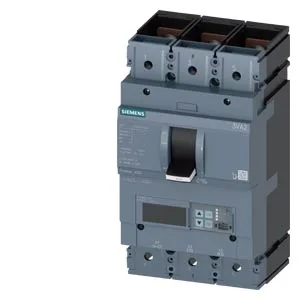
Its electronic trip unit is adjustable from 600 A to 4000 A full-scale, with an initial setting of 80 A, meaning you dial in the exact overload threshold for the downstream load, not a fixed rating. At 415 V and 440 V it still holds 187 kA, dropping to 121 kA at 500 V and 7.5 kA at 690 V; that steep roll-off above 500 V means you verify the available fault current at the point of installation before committing the BOM line. Thermal derating is baked into the spec: the breaker carries 400 A continuously at ambient up to 50 °C, then drops to 375 A at 55 °C, 350 A at 60 °C, 325 A at 65 °C, and 300 A at 70 °C. The 96 W maximum power loss at rated load matters for enclosure heat-rise calculations; that's the heat you need to vent through the gland plate or forced-air path. 248 mm tall, 138 mm wide, 110 mm deep. 3-pole form factor.
Availability and pricing confirmed at quote time.
Integration and compliance notes
No undervoltage release and no auxiliary release fitted. Communication function onboard. The trip indicator (a mechanical flag visible on the front cover) gives a clear visual that the breaker has tripped on fault, not just been switched off — useful for a technician walking a lineup.