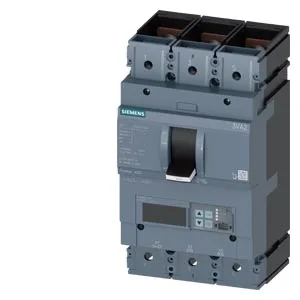
The Siemens 3VA2340-6JQ32-0AH0 is a SENTRON molded case circuit breaker (MCCB) rated for 400 A continuous current at 40 °C through 50 °C, with a 3-pole configuration and an ETU560 electronic trip unit. The interrupting ratings tell you where it can go: 242 kA at 240 V, 187 kA at 415 V and 440 V, 121 kA at 500 V, and 40 kA at 690 V. The ETU560 is a communicating electronic trip unit, so it can talk to a higher-level system for monitoring and coordination. Let me show you why the thermal derating matters: at 55 °C the continuous rating drops to 375 A, at 60 °C to 350 A, and at 70 °C to 300 A.
Mounting and integration — fits a standard MCCB footprint
This breaker measures 248 mm high by 138 mm wide by 110 mm deep. That depth is the dimension from the mounting surface to the front of the breaker — important when you're planning gland-plate clearance or door clearance in a panel. The width of 138 mm is standard for a 400 A frame in the SENTRON 3VA family, so it will drop into the same mounting cutout as other 3VA breakers of this frame size.
Trip unit and communications — ETU560 with communication function
The ETU560 trip unit provides adjustable long-time, short-time, instantaneous, and ground-fault protection curves, and it includes a communication function (likely PROFIBUS or PROFINET, though the exact protocol isn't listed in these specs). That communication function lets the breaker report status, trip events, and load current to a PLC or SCADA system — useful for predictive maintenance or remote troubleshooting. The trip indicator is present, so after a trip you can see whether it was a fault or manual operation.