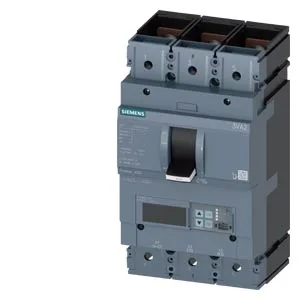
400 A MCCB with 242 kA interrupting capacity — line protection for high-fault panels
The Siemens SENTRON 3VA2340-6JQ32-0BC0 is a 3-pole molded case circuit breaker rated for 400 A continuous at ambient temperatures up to 50 °C, with no derating needed in that range. Above 55 °C it derates linearly to 300 A at 70 °C (–). The interrupting capacity peaks at 242 kA at 240 V, dropping to 187 kA at 415/440 V, 121 kA at 500 V, and 7.5 kA at 690 V. That 242 kA figure at 240 V means it safely clears faults on high-capacity transformer secondaries or busway taps without cascading upstream — a key spec for service-entrance or main-switchboard positions. Designed for line protection, this MCCB integrates an undervoltage release (UVR) as the auxiliary release and carries 2 HQ auxiliary switches. The UVR trips the breaker if control voltage drops below a set threshold — common in safety circuits or generator-transfer schemes where loss of control power must open the main feeder. Communication function is onboard, enabling remote monitoring or integration into a plant-wide power management system. Physical footprint: 248 mm high, 138 mm wide, 110 mm deep. That 110 mm depth is the dimension that matters most when fitting into existing panel gutters or alongside busbar stacks — verify the enclosure depth before committing the BOM line.
Thermal performance and power loss
Maximum power loss is 98.5 W at full rated current. That figure drives ventilation requirements inside the enclosure — if you're packing multiple breakers in a sealed panel, sum the losses and size the cooling accordingly. The breaker operates from -25 °C to 70 °C ambient and stores from -40 °C to 80 °C.
Adjustable trip unit — 80 A to 400 A
The trip unit is adjustable from 80 A minimum to 400 A full-scale. That range lets you fine-tune the breaker to the actual load without swapping the frame — useful when the same panel design is deployed across multiple sites with different feeder sizes. No trip indicator and no voltage trigger on this variant; the UVR handles the voltage-based trip function.
