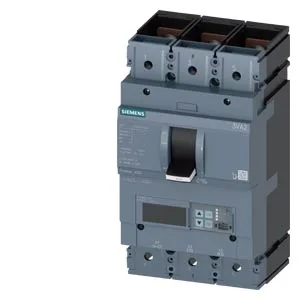
400 A MCCB with 242 kA interrupting capacity — what the ratings mean for your panel
The Siemens SENTRON 3VA2340-6JQ32-0CH0 is a 3-pole molded case circuit breaker rated for 400 A continuous current (Iu) across ambient temperatures up to 50 °C, derating to 300 A at 70 °C. That 400 A rating holds steady from 40 °C through 50 °C, so you don't lose headroom in a warm enclosure — a common pain point with breakers that derate aggressively above 40 °C. The interrupting capacity hits 242 kA at 240 V, 187 kA at 415/440 V, and still 40 kA at 690 V, which means it can handle high-fault scenarios downstream of large transformers or in industrial mains distribution without needing a current-limiting upstream device. The ETU560 electronic trip unit gives you adjustable long-time, short-time, instantaneous, and ground-fault protection curves — this is a selective breaker, not a thermal-magnetic generalist. Built for line protection (cable and busbar feeder duty), it includes an undervoltage release (UVR) as standard, a trip indicator, and a communication function. The auxiliary contact configuration is 2 auxiliary switches plus 1 trip alarm switch (HQ type).
Panel fit and integration — dimensions and mounting
The breaker measures 248 mm high, 138 mm wide, and 110 mm deep. That 110 mm depth is the body only — add clearance for rear-mounted accessories (the UVR coil, auxiliary switches) and the communication module pigtail. It mounts on a standard DIN rail or via the four screw-mounting points on the base. The 138 mm width for a 3-pole 400 A frame is typical for SENTRON 3VA2 breakers; verify the existing panel cutout if replacing a different manufacturer's 400 A frame, as the mounting hole pattern may differ.
Thermal management — 98.5 W max power loss
At full rated current, the breaker dissipates up to 98.5 W. In a sealed or tightly packed enclosure, that heat needs to be considered for the internal temperature rise — especially since the breaker itself derates above 55 °C. For a panel running at 40 °C ambient, the 400 A rating is safe; if the enclosure internal ambient hits 60 °C, you're down to 350 A. The storage temperature range (-40 to 80 °C) is wider than the operating range (-25 to 70 °C), which is typical — the storage limit governs handling and warehousing, not running conditions.
