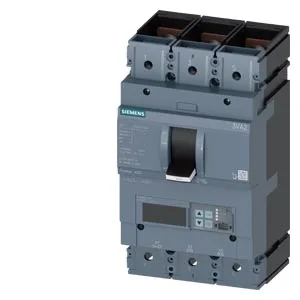
The Siemens SENTRON 3VA2340-6JQ32-0DA0 is a 3-pole molded case circuit breaker (MCCB) configured for line protection, carrying a rated continuous current Iu of 400 A that holds flat from 40 °C through 50 °C — meaning no derating needed in a typical 40 °C panel environment. Above 50 °C, the current rating steps down: 375 A at 55 °C, 350 A at 60 °C, 325 A at 65 °C, and 300 A at 70 °C. That thermal curve is the one to check if the breaker sits near transformers or other heat sources inside the enclosure. At 240 V it interrupts 242 kA; at 415 V and 440 V it holds 187 kA; at 500 V it still manages 121 kA; and at 690 V it drops to 40 kA. The electronic trip unit is an ETU560, and the breaker includes an undervoltage release (UVR) plus a communication function — so it can be integrated into a monitoring or remote-trip scheme. There is no auxiliary contact on this variant, and no voltage trigger or phase failure detection built in.
The breaker dimensions — 248 mm height, 138 mm width, 110 mm depth — fit the standard SENTRON 3VA frame footprint. The 110 mm depth is the dimension to watch when the gland plate or door clearance is tight; the 138 mm width means a 3-pole unit occupies roughly three 45 mm module spaces on the rail.