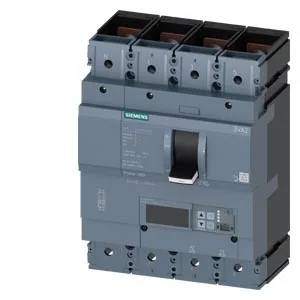
That makes it a coordination-friendly breaker for selective tripping downstream of a main, not just a thermal-magnetic brute-force device. Breaking capacity is what gets an MCCB spec'd into a fault study. This unit delivers 242 kA at 240 V, 187 kA at 415 V and 440 V, 121 kA at 500 V, and 7.5 kA at 690 V. That's a high-interrupting-capacity (HIC) class breaker, not an economy line. Thermal derating matters when you're packing breakers into a warm enclosure. The breaker holds 400 A up to 50 °C ambient; at 55 °C it derates to 375 A, at 60 °C to 350 A, at 65 °C to 325 A, and at 70 °C to 300 A. If your panel sits in a non-conditioned space — say, a Saudi switchroom hitting 55 °C — you're losing 25 A of headroom. Factor that into the load schedule. Mechanical footprint: 248 mm tall, 184 mm wide, 110 mm deep.
Where it bolts in
Terminal spread on a 4-pole frame means phase-to-phase clearance is built in — no need for additional phase barriers up to the rated voltage. The ETU850 trip unit supports communication — that's the 'Communication Function Yes' flag in the specs. That means it can talk to a higher-level energy management system or PLC via the 3VA communication module (ordered separately), giving you remote trip status, current metering, and alarm annunciation. If you're retrofitting an older panel that had a dumb thermal-magnetic breaker, this adds a data stream without rewiring the load side.