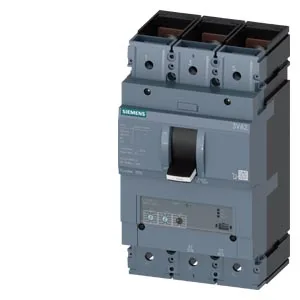
The Siemens SENTRON 3VA2340-7HL32-0CC0 is a 3-pole molded case circuit breaker rated 400 A continuous, with an adjustable trip range from 600 A up to 4,000 A — meaning you can dial the long-time pickup to match the load without swapping the breaker frame. Its interrupting capacity runs 330 kA at 240 V, 242 kA at 415 V and 440 V, 187 kA at 500 V, and 7.5 kA at 690 V — the steep drop at 690 V tells you this is a 600 V class frame, not a 690 V design. For a 480 V distribution board the 242 kA at 440 V is the relevant figure; it gives you headroom over a typical 65 kA or 100 kA available fault current. Thermal derating is published per degree: full 400 A up to 50 °C, then 385 A at 55 °C, 370 A at 60 °C, 355 A at 65 °C, and 340 A at 70 °C. If your panel ambient runs 55 °C, you are derating 15 A off the nameplate — plan the tap accordingly. Designed for line protection, not feeder or generator protection. The basic switch inside is order code 3VA2340-7HL32-0AA0, so if you are swapping just the trip unit or the mechanism, that is the core subassembly.
Mounts in a standard MCCB cutout: 248 mm tall, 138 mm wide, 110 mm deep — the 138 mm width is a 3-pole frame, so it occupies roughly 5.43 inches of panel width per pole. Verify the mounting base footprint against your existing bus or backplate before ordering. The storage range is wider because it is not carrying current — that is a handling and warehousing limit, not a running condition.
What it does not have
This is a plain line-protection breaker with undervoltage release and auxiliary contacts — no electronic trip unit, no Modbus, no earth-leakage module built in.