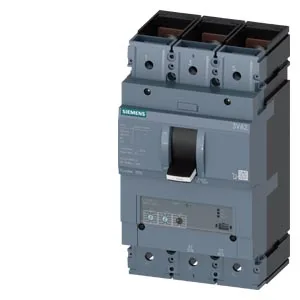
The Siemens 3VA2340-7HL32-0DC0 is a 3-pole SENTRON molded case circuit breaker (MCCB) rated for 400 A continuous current from 40 °C through 50 °C ambient — no derating needed in a typical ventilated enclosure up to that temperature. Above 50 °C the curve steps down: 385 A at 55 °C, 370 A at 60 °C, 355 A at 65 °C, and 340 A at 70 °C. The interrupting ratings are what make this part stand out: 330 kA at 240 V, 242 kA at 415 V and 440 V, 187 kA at 500 V, and 7.5 kA at 690 V. The auxiliary switches give remote status feedback (open/closed/tripped) to a PLC or indicator lamp without extra wiring.
The 110 mm depth leaves room for rear-connection bus bars or a cable-entry gland plate without crowding the enclosure door.
It coordinates downstream with SENTRON load centers or smaller MCCBs; the 330 kA at 240 V gives full selectivity with upstream fuses or a main breaker rated below that level. For a 400 A feeder on a 2,000 kVA transformer, this holds the fault without upstream trip.