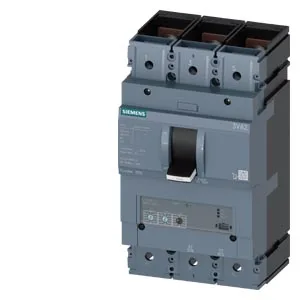
What this MCCB carries and where it fits
The Siemens 3VA2340-7HL32-0JL0 is a SENTRON molded case circuit breaker (MCCB) rated for 400 A continuous current (Iu) with a rated insulation voltage of 800 V. Its interrupting capacity reaches 330 kA at 240 V, 242 kA at 415 V and 440 V, 187 kA at 500 V, and 52.5 kA at 690 V — figures that cover most industrial service-entrance and feeder applications. The ETU320 electronic trip unit handles line protection (no ground-fault or communication module). A shunt trip (STL) auxiliary release is integrated, and the auxiliary contact block provides 2 auxiliary switches plus 1 trip alarm and 1 electrical alarm switch (HQ version). This is a 3-pole, panel-mount MCCB with a depth of 110 mm, width of 138 mm, and height of 248 mm — dimensions that matter when swapping into an existing SENTRON or third-party MCCB bucket. Maximum power loss is 96 W, so ventilation in the enclosure should account for that thermal load at full rating.
Thermal derating and endurance
The breaker holds its full 400 A rating from 40 °C up to 50 °C ambient. Above that, it derates: 385 A at 55 °C, 370 A at 60 °C, 355 A at 65 °C, and 340 A at 70 °C. Operating ambient range is -25 °C to 70 °C; storage range is -40 °C to 80 °C. Mechanical endurance is rated at 15,000 cycles — a figure that suits frequent switching applications like compressor or pump panels where the MCCB doubles as a disconnect.
What the ratings mean for your panel
The 330 kA at 240 V and 242 kA at 415 V are the SCCR (short-circuit current rating) values — the maximum fault current this breaker can safely interrupt without welding contacts or rupturing the case. In a 480 V panel with a transformer-fed bus that can deliver 200 kA, this breaker has headroom. The 800 V rated insulation voltage (Ui) means it is suitable for 690 V systems common in European industrial installations. The ETU320 release is an electronic trip with fixed time-current curves; it does not offer communication or ground-fault detection, so if your spec requires those, you need a different release variant in the 3VA2 family.
