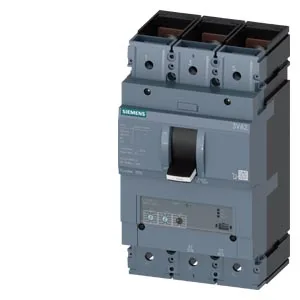
The Siemens SENTRON 3VA2340-7HL32-0KL0 is a 3-pole molded case circuit breaker (MCCB) rated for 400 A continuous current at 40 °C, with an adjustable thermal-magnetic trip unit covering 600 A to 4 000 A. It is designed for line protection in distribution panels and switchgear, where the high interrupting capacity — 330 kA at 240 V, 242 kA at 415/440 V, 187 kA at 500 V, and 7.5 kA at 690 V — allows it to be installed upstream in high-fault locations without cascading failure.
The 400 A continuous rating holds flat from 40 °C through 50 °C, then derates linearly: 385 A at 55 °C, 370 A at 60 °C, 355 A at 65 °C, and 340 A at 70 °C. The adjustable trip range (600 A minimum to 4 000 A maximum) covers a wide band of load sizes, but the breaker's own frame and continuous rating set the practical ceiling — you cannot continuously load it past 400 A regardless of the trip setting. The high-end trip adjustment is for short-circuit and instantaneous protection coordination, not for increasing the continuous ampacity. Breaking capacity varies sharply with system voltage. At 240 V it handles 330 kA — enough for most transformer-secondaries.
No ground-fault monitoring or communication function on this order code.
Physical footprint and integration
Depth of 110 mm leaves room for rear-connected busbars in a typical 600 mm deep enclosure.