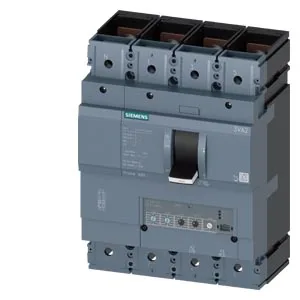
What it is and what it does
The Siemens 3VA2340-7HM42-0AA0 is a SENTRON molded case circuit breaker (MCCB) rated for line protection, carrying 400 A continuous at 40 °C with an ETU330 electronic trip unit. It's a 4-pole unit, so it switches all three phases plus the neutral — common for North American and European distribution panels that need a switched neutral or ground-fault sensing on the full circuit. The breaking capacity is serious: 330 kA at 240 V, 242 kA at 415/440 V, 187 kA at 500 V, and still 7.5 kA at 690 V. That 330 kA figure at 240 V means it can interrupt a fault current up to 330,000 amps — relevant for high-capacity transformer secondaries or large motor control centers where the available fault current is high. The 7.5 kA at 690 V is lower but still covers most industrial 690 V systems with moderate fault levels. Current rating is temperature-dependent: full 400 A from 40 °C to 50 °C, then derates to 385 A at 55 °C, 370 A at 60 °C, 355 A at 65 °C, and 340 A at 70 °C. If your panel runs hot — say, a packed enclosure near a furnace or in a Middle East plant — you need to account for that derating. The 340 A at 70 °C is still a lot of headroom for most feeders.
Integration and mounting
Physical footprint: 184 mm wide, 248 mm tall, 110 mm deep. That's a standard 4-pole MCCB form factor for a 400 A frame — fits most DIN-rail or panel-mount enclosures with the usual cutout. The IP40 on the front means it's protected against tools and wires >1 mm, fine for a closed panel; no washdown rating, so keep it inside the cabinet. The N-conductor protection is adjustable: can be set to OFF, 50%, or 100% of the phase current. That's useful for systems where the neutral doesn't need full protection (e.g., balanced three-phase loads) or where you want to coordinate with downstream breakers. Optional motor drive is available for remote operation — useful if this breaker is in a remote substation or a hard-to-reach location in the plant.
Lifecycle and sourcing reality
The ETU330 trip unit is the electronic overcurrent release, with adjustable L (long-time), S (short-time), I (instantaneous), and G (ground-fault) protection curves. That's the standard electronic trip for this frame — no communication function on this variant, so no remote monitoring without adding an external module.
