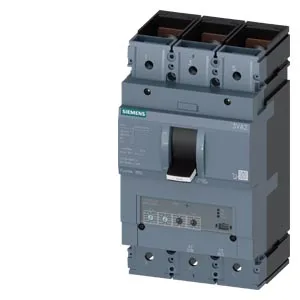
It carries a continuous rated current of 400 A at 40 °C — that's the current it can pass continuously without tripping on thermal overload. The 400 A rating holds steady up to 50 °C; above that it derates to 385 A at 55 °C, 370 A at 60 °C, 355 A at 65 °C, and 340 A at 70 °C. Breaking capacity is the other headline: 330 kA at 240 V AC, 242 kA at 415 V, and 187 kA at 500 V. These numbers tell you this breaker can sit at the main disconnect where fault currents are highest, and coordinate downstream without blowing up. Three poles, line-protection design (not motor-protection — no overload relay built in). The basic switch is order code 3VA2340-7HN32-0AA0; this variant adds the auxiliary and alarm contacts.
That's a 3-pole frame that fits standard MCCB mounting footprints — no oddball cutout.
How it compares to a sibling: 3VA2116-5HL32-0AK0
The 3VA2116-5HL32-0AK0 is a smaller-frame MCCB — 160 A continuous, lower breaking capacity, and a different accessory layout. If your panel was designed around that 160 A frame, the 3VA2340-7HN32-0AJ0 will not drop in without rewiring: the mounting hole pattern and bus-bar spacing differ between frame sizes. The 400 A version is physically larger (248 mm vs. a shorter frame) and needs more clearance for the higher interrupting ratings. Stick with the frame size your panel was built for unless you're doing a full re-design.