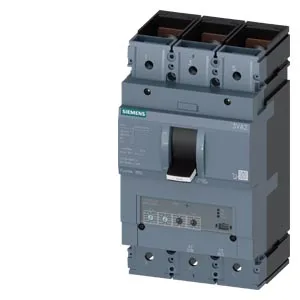
It's a line-protection device built for main or feeder duty in distribution panels — the kind of breaker you spec when you need adjustable protection curves and high fault-current handling in a compact frame. The interrupting capacity tells you where this thing lives in the hierarchy: 330 kA at 240 V, 242 kA at 415 V and 440 V, 187 kA at 500 V, and 52.5 kA at 690 V. That's utility-grade fault clearing — it sits upstream of smaller feeder breakers and needs a panel SCCR rated to match.
Ratings that matter for panel fit
At 55 °C it's 385 A, at 60 °C it's 370 A, at 65 °C it's 355 A, and at 70 °C it's 340 A. That derating curve is what you check if the breaker sits near transformers or drives. Maximum power loss is 98.5 W — that's heat you need to account for in the enclosure thermal calculation. Mechanical endurance is 15,000 operations latching. That's a standard figure for a fixed-mount MCCB in distribution — not a switching-duty contactor, but fine for its role as a protective device that operates infrequently.
Trip unit and auxiliary hardware
It's a straight-line protection breaker — add external modules if you need those features.
The 110 mm depth means it fits in shallow enclosures where a taller frame would force a deeper can.