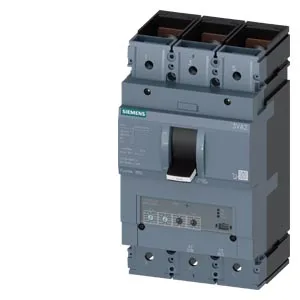
It is a 3-pole unit designed for line protection, carrying a 330 kA interrupting rating at 240 V and 242 kA at 415 V, which makes it suitable for high-fault-current industrial distribution panels where selectivity with upstream gear is a requirement.
For a panel running warm — say 55 °C ambient — you are still at 385 A, which is a 3.75% margin below the label. That matters if your continuous load is right at 400 A and the enclosure runs hot; you need the thermal curve for a proper coordination study.
At 240 V the breaker clears 330 kA symmetrical. At 500 V it drops to 187 kA, and at 690 V it clears 7.5 kA. For a 480 V line-to-line panel (common in North America) the relevant figure is the 500 V rating — 187 kA — which still covers most utility-fault scenarios.
Built-in undervoltage release and auxiliary switch complement
That is enough for a PLC input card to distinguish between a manual-off and a trip event without extra interposing relays.
Mechanical footprint: 110 mm deep, 138 mm wide
The unit measures 110 mm deep, 138 mm wide, and 248 mm tall.
The manufacturer lists this part as current-production (active lifecycle stage). That means it is still in the standard catalog and not subject to a last-time-buy notice.